


What Are Foot Orthotics?

Orthotics, also called foot orthoses or orthotic insoles, are therapeutic shoe inserts designed to enhance foot function and alignment, relieve pain in the feet and lower body, and support overall foot health and longevity.
Foot orthotics are made to replace the existing soles in your shoes. They work by redistributing weight, pressure and shock absorption while you’re standing, walking, running or playing sports. This prevents injury and pain caused by the overstressing of bones, muscles, tendons and ligaments in your feet.
Do I Need Orthotic Insoles?
For many people, the soles in their shoes don’t provide the right support in the right places. Because these soles are mass produced, they’re “one size fits all” in terms of the support they offer (if any).
This isn’t necessarily a problem if you’re blessed with highly functional, perfectly aligned, pain-free feet. Unfortunately, most of us aren’t so lucky. For instance, it’s estimated that around 60% of the adult population have some degree of over-pronation – that is, fallen arches or flat feet that cause the foot to roll excessively inward while walking.
For those with this foot condition, a pair of orthotic insoles can provide much-needed arch support that helps keep their gait in proper alignment. This in turn prevents or alleviates the pain that can result from muscles, tendons and joints “working overtime” to compensate for a misaligned gait.
Some other foot conditions and injuries that can be managed with orthotics include:
- Under-pronation (high arches)
- Plantar fasciitis (heel pain)
- Metatarsalgia (pain in the ball of the foot)
- Ankle joint pain
- Arthritis
- Bunions
Orthotics can also alleviate some types of knee, hip and back pain that stem from structural issues with the feet.
Generic vs. Custom Orthotics
Generic or “over the counter” orthotic insoles can be found on the shelves of many chemists in Sydney and around the country. While these shoe inserts are affordable and can offer a degree of support and comfort beyond a normal sole, they are still “one size fits all” and not customised to support your feet.
Not only are everyone’s feet different, it’s normal for foot structures and shapes to differ within the same individual. That is, your left foot may need more arch support than your right, or vice versa. This is why custom or “prescription” orthotics are by far the better option.
State of the art diagnostics

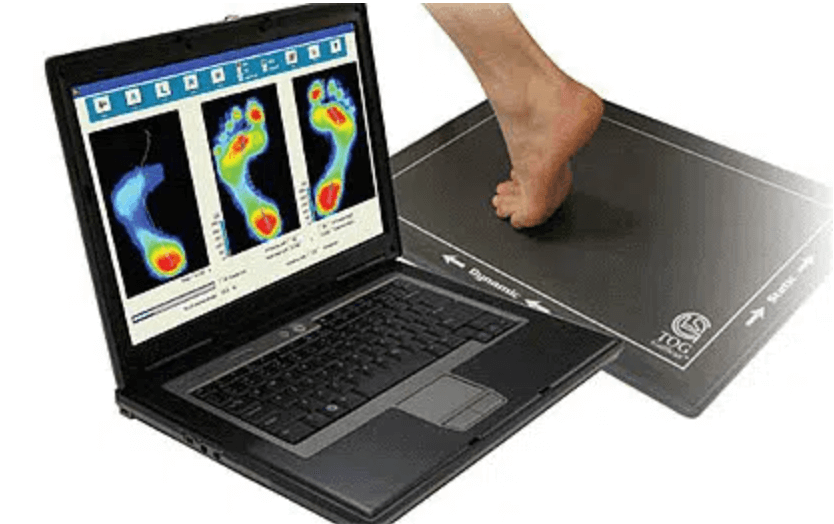
At The Physicaltherapy Centre, we use Gait Scan Technology to design foot orthotics. This is a state of the art diagnostic tool and digital casting device that allows us to analyse our patients’ biomechanics and customise orthotic products to their unique needs.
Developed by The Orthotic Group in Canada, Gait Scan Technology eliminates any human error that is typical during traditional orthotic fittings. Rather than using dated plaster of Paris castings, it designs an orthotic using digital data gathered during a dynamic assessment of your unique foot type and biomechanics.
Unlike other digital orthotic design tools, which typically have you stand stationary on a footplate as your feet are digitally scanned, Gait Scan Technology has you walk or run across a gait plate to analyse the biomechanics of your feet in motion. The design of the orthotic is thus better tailored to support your foot’s natural movements.
What Types of Orthotics are Available?
Our custom made orthotics are tailored to each patient’s unique biomechanical needs and crafted from high quality, long lasting materials.
We offer orthotic devices in two size types:
Full Size Orthotics
Full size orthotics are suitable for replacing the soles in running shoes, walking shoes, sports shoes and other types of practical footwear.
Half Size Orthotics
Half size orthotic insoles are designed for use with office shoes and dress shoes. This is because full size orthotics are too big to fit into most types of formal shoes, which are typically narrower than casual shoes.
Our team is often asked if our half size orthotics can be worn with high heels. It’s technically possible with some high-heeled shoe designs, especially if the heels are on the lower side. But in general, we don’t recommend it – and as any podiatrist will tell you, wearing high heels for extended periods can be detrimental to foot health.
Will I need orthotics forever?
The answer is a complicated one. Nobody has a perfectly functioning foot. There are many people out there who have excellent foot biomechanics, with seemingly less reason to use orthotics, but it’s unlikely that anyone’s feet function 100% problem-free under load.
Conversely, there are many people who suffer foot pain, knee pain and other lower limb conditions related to aberrant foot biomechanics. Expert manual therapy combined with foot muscle exercises can negate the need for orthotics. This requires a lot of commitment however, and there’s always the risk that symptoms will return if self-management falls by the wayside.
Wearing well-designed orthotics can be a great way to keep your foot, ankle, knee, hip or even lower back pains at bay. You will not become “dependent” – human beings are no more dependent on wearing orthotics than we are on wearing shoes. So, if you already wear shoes and find that orthotics provide relief, you may as well keep them in your shoes all the time.
Get scanned today!
An orthotic gait scan takes about two minutes to complete and ten minutes to run through the results.
We strive to make our services accessible to everyone – please ask us about our flexible payment plans. You may also wish to enquire with your health insurance provider, as some private health funds provide rebates for the cost of orthotics.
Don’t wait any longer to walk and run pain-free. Enquire today to discover the difference custom orthotics can make in your life.